File: Supply chain traceabilityEvidence checked 27 October 2026General information only
SupplyChainTraceability.site
The Custody File: identity, events, evidence
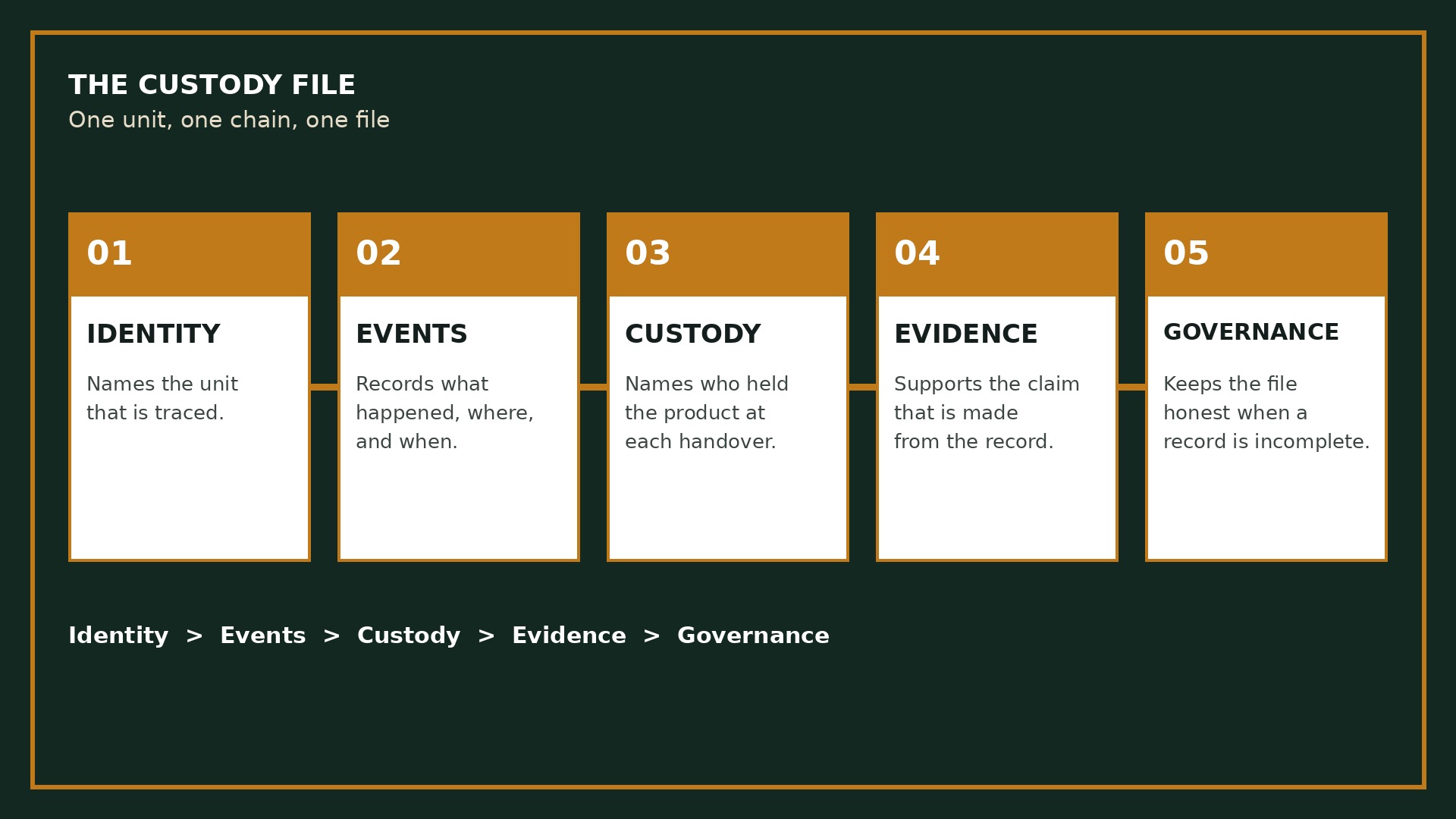
Diagram of the custody chain in five steps: Identity, Events, Custody, Evidence, Governance
One unit, one chain, one file: identity, events, and evidence, in that order.

The chain, in five steps

Identity names the unit. Events record what happened. Custody names who held it. Evidence supports the claim. Governance keeps the file honest.

01 IdentityNames the unit that is traced.02 EventsRecords what happened, where, and when.03 CustodyNames who held the product at each handover.04 EvidenceSupports the claim that is made from the record.05 GovernanceKeeps the file honest when a record is incomplete.

Open a file

File 01Identity and foundationsWhat a traced product is, what unit is being traced, and what a record must connect before any claim is made.14 guidesFile 02Lot, batch and serial traceabilityChoosing the unit of trace: product type, lot, batch, serial item, or logistics unit, and what each level can and cannot prove.13 guidesFile 03Event records and custody eventsReceipts, transformations, handovers and dispatches as events, with the context that lets one event link to the next.13 guidesFile 04Chain of custodyWho held a product or material, in what order, and what evidence supports each handover.12 guidesFile 05Supplier data agreementsWhat to agree with a supplier before the first shipment: identifiers, event data, evidence, timing, and access.12 guidesFile 06Manufacturing genealogyInputs, transformations and outputs inside a plant: how a finished batch is connected back to its input lots.12 guidesFile 07Data governance and evidenceOwnership, completeness, retention and review of traceability data, and what a record can honestly support.12 guidesFile 08Interoperability and standardsIdentifiers, vocabularies and message formats that let records travel between systems without losing their meaning.12 guidesFile 09Recall traceback and forward tracingFinding the source of a problem and the destinations of affected product, quickly and with a defensible scope.11 guidesFile 10Traceability software and systemsEvaluating, implementing and running the systems that hold the record, judged on the record they produce.11 guidesFile 11Digital product passportsProduct-level digital records, their identifiers, data carriers, and the traceability work behind them.12 guidesFile 12The EU forced labour regulationRegulation (EU) 2024/3015: scope, the product ban mechanism, and the traceability preparation it calls for.13 guidesFile 13United States import enforcementSection 307 of the Tariff Act, the Uyghur Forced Labor Prevention Act, and the evidence an importer may be asked to show.13 guidesFile 14Responsible sourcingDue diligence, risk, and supplier engagement, and where traceability supports a sourcing claim and where it does not.12 guidesFile 15Supplier mapping and facility identificationMapping tiers, sites and facilities, and identifying each facility in a way that can be checked.12 guidesFile 16Material originOrigin, transformation and mixing of materials, and what an origin claim needs behind it.12 guidesFile 17Supplier evidence managementCollecting, reviewing, storing and acting on supplier evidence, and closing the gaps it reveals.13 guidesFile 18Food and agriculture traceabilityLots, harvests, processing and distribution in food chains, where speed and batch scope decide the outcome.13 guidesFile 19Textiles and apparel traceabilityFibre, yarn, fabric and garment stages, and the chain of custody behind a fibre or origin claim.12 guidesFile 20Electronics, minerals and batteriesComponents, minerals and battery materials, where long chains and mixed inputs make the record harder to hold together.13 guides
View all 247 guides

How this file works

Three rules. First, no invented numbers and no clearance promises: figures come from official sources, are attributed, and carry the date they were checked; worked examples use labelled illustrations, never real shipments. Second, frameworks are never blended: Regulation (EU) 2024/3015 is not Section 307, and the UFLPA presumption is not an EU ban, and each guide says which system it is describing. Third, corrections are published, not buried: the corrections page records what changed and why.

This site does not recommend a platform, supplier, auditor, or service, and it does not generate leads. It explains the record so a reader can judge a supplier claim, an import file, or a professional's advice well, and routes product-specific decisions to the official sources and to qualified advisers in the relevant jurisdiction.

Try the worked record in the traceability lab, or work through the implementation checklist for one product family.

How a trace is filed

  • Define the unit of trace first, and read its record, not a summary of another product's record.
  • Record events as they happen, with place, time, custodian, and quantity.
  • Confirm every handover on both sides, so custody has no silent gap.
  • Keep supplier evidence current, and treat an expired or inconsistent document as a gap, not a filing delay.
  • Re-check before relying on a record, because a supplier, a facility, or a framework can change between shipments.